Anticipating India by Gupta Shekhar
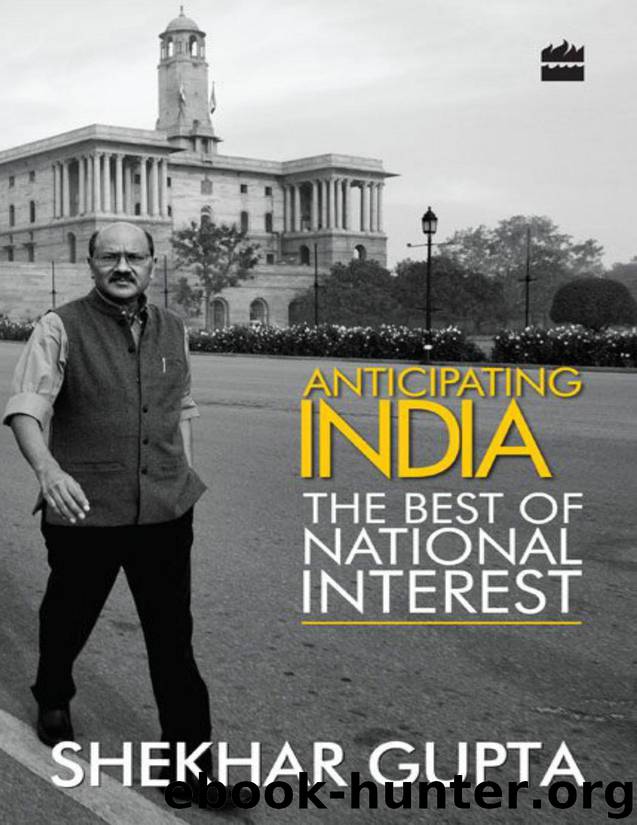
Author:Gupta, Shekhar [Gupta, Shekhar]
Language: eng
Format: mobi
Tags: POLITICS AND GOVERNMENT
Published: 0101-01-01T00:00:00+00:00
LOK SABHA, 2014
That election is now wide open. The winner will be the party which
makes the boldest move away from Old India Politics.
26 February 2011
The first week of a functioning Parliament in nearly six months has made one thing dramatically clear:
that the election of 2014 is no longer a done deal. Opening exchanges showed a new energy in the
opposition, particularly the BJP. In a debate that must rank among the classics of our recent
parliamentary history, Sushma Swaraj notably worsted veteran Pranab Mukherjee, point by point, and
then gave us one of those moments you cherish in parliamentary politics, by giving a smiling Pranabda
a friendly hug at the end of the day. It’s been a long time since we saw a moment like this in our
Parliament.
The BJP’s mood is easier to explain. At this time last year, it was staring at a hopeless future. Its
top leaders engaged in a Mahabharata of sorts, no happy turning point in sight. Across the ideological
fence, Congressmen were sharpening the knives as well, to stab their own in the back as they
jockeyed for the spoils of an election already ‘won’ in 2014. And, in the process, brutally
undermining their own government much like a body afflicted with some autoimmune disease that
begins attacking itself. Both sides would acknowledge that an upset of sorts has now been caused.
Not that the tables have turned but the next election has been thrown open in a way nobody had
anticipated.
Five things have made it happen, three of which are rooted in our major states, Andhra Pradesh,
Bihar and Tamil Nadu. The UPA can’t repeat its near-sweep of 2004 and 2009 in Andhra and Tamil
Nadu. And the disaster of Bihar stunned the Congress. Even more than its tally of four seats, the
shocker was the fact that its candidates lost their deposits in 221 out of the 243 seats it contested. For
the NDA, on the other hand, the success of Bihar showed what kind of political gains were available
in the new India if you were willing to dump old, exclusionist, negative agendas. Bihar has, therefore,
emerged as that fortuitous turning point that an opposition in the dumps prays for. The two factors
outside of these states are the obvious ones: the withering damage the UPA has suffered because of
corruption charges and the discordant, disruptive noises that began emerging from within the
Congress exposing its disastrous complex of ideological laziness, conflicting ambitions and political
imprudence.
To understand this shift, National Interest has to revisit its long-held theory that an Indian national
election is now like a best-of-nine-sets tennis match—whoever wins five of these will take the
trophy. These nine ‘sets’ are our large states where electoral fortunes can change: Uttar Pradesh,
Bihar, Andhra, Maharashtra, Rajasthan, Madhya Pradesh, Tamil Nadu, Kerala and Karnataka.
Together, these account for 351 seats in the Lok Sabha, so whichever coalition wins five of these is
likely to cross the 200 mark anyway. That 200 is the new 272 in our Lok Sabha now, as you would
presume that the same coalition would collect some more seats out of the remaining 192, and if it is
still short, some small parties with ideologies totally fungible with power would join it.
Download
This site does not store any files on its server. We only index and link to content provided by other sites. Please contact the content providers to delete copyright contents if any and email us, we'll remove relevant links or contents immediately.
| Anthropology | Archaeology |
| Philosophy | Politics & Government |
| Social Sciences | Sociology |
| Women's Studies |
The Secret History by Donna Tartt(19104)
The Social Justice Warrior Handbook by Lisa De Pasquale(12197)
Thirteen Reasons Why by Jay Asher(8919)
This Is How You Lose Her by Junot Diaz(6894)
Weapons of Math Destruction by Cathy O'Neil(6285)
Zero to One by Peter Thiel(5808)
Beartown by Fredrik Backman(5768)
The Myth of the Strong Leader by Archie Brown(5513)
The Fire Next Time by James Baldwin(5454)
How Democracies Die by Steven Levitsky & Daniel Ziblatt(5225)
Promise Me, Dad by Joe Biden(5157)
Stone's Rules by Roger Stone(5091)
A Higher Loyalty: Truth, Lies, and Leadership by James Comey(4967)
100 Deadly Skills by Clint Emerson(4932)
Rise and Kill First by Ronen Bergman(4797)
Secrecy World by Jake Bernstein(4756)
The David Icke Guide to the Global Conspiracy (and how to end it) by David Icke(4724)
The Farm by Tom Rob Smith(4517)
The Doomsday Machine by Daniel Ellsberg(4493)
